IJFMA CRESCINE EDITORIAL
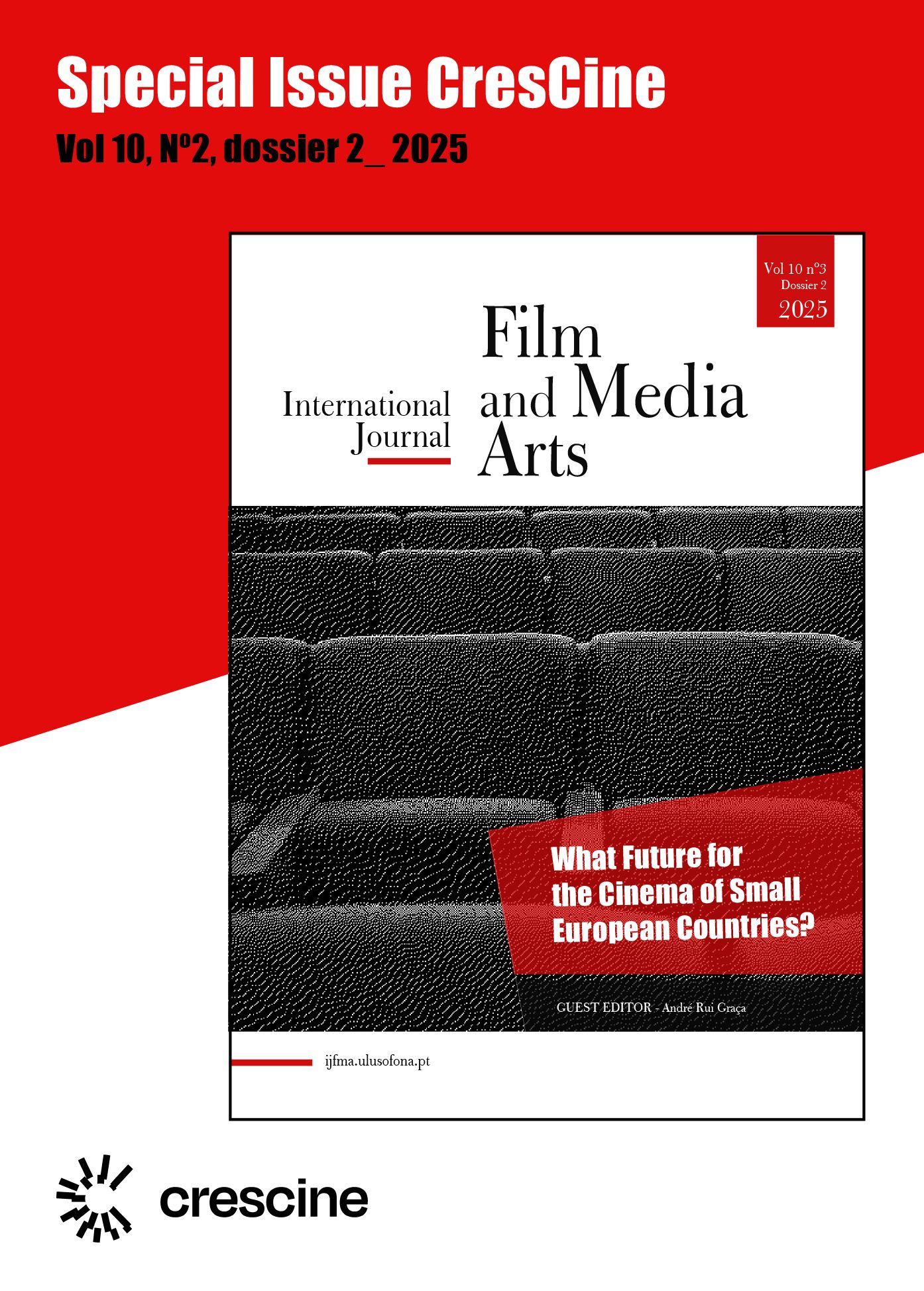
The question that titles this special issue of the International Journal of Film and Media Arts - What future for the cinema of small European countries? - emerges from a moment of profound transformation across the global film and audiovisual landscape, in which long-standing industrial, cultural, and theoretical frameworks are being reconfigured. In this context, the cinema of small European countries offers not a marginal case, but a critical vantage point from which to rethink the present and future of film and media. Indeed, this focus on smallness and the potential that it can encapsulate, was the guiding principle of the CresCine project (Horizon Europe, 2023-2026), which overarchingly frames this special issue.
Historically, film and media studies have often been structured around a set of dominant binaries - chief among them the opposition between Hollywood and “the other”; or between global and national cinemas. While traditional frameworks have been productive to a certain extent, they have also become exhausted and chronically overlooked the specificities of smaller film industries, whose conditions of production, circulation, and reception operate according to specific, often idiosyncratic, logics and logistics. This special issue seeks to move beyond such reductive paradigms by foregrounding the diversity, resilience, and complexity of small European cinemas as both cultural and industrial formations.
The contributions gathered here reflect a shared understanding of cinema as a phenomenon that cannot be disentangled from its broader socio-economic, political, and technological contexts. Across the issue, cinema is approached not only as an artistic practice but also as a site where tensions are expressed between local identities and global markets, cultural policy and economic constraints, and tradition and innovation. What we present here is the result of a relatively long and careful selection and peer-review process.
Some papers engage directly with questions of cultural identity and representation. Tommy Kibera Kiilu’s comparative analysis of Portugal and Slovenia examines how small national cinemas articulate and negotiate cultural specificity within constrained industrial contexts. Similarly, Tetiana Krysanova’s study of contemporary Ukrainian cinema foregrounds the role of film in representing trauma and collective memory, highlighting the capacity of audiovisual texts to engage with pressing historical and political realities. Following from a tradition in film studies that associates artistic expression with the zeitgeist, together, these contributions underscore the continued relevance of cinema as a medium through which the topic of cultural identity in peripheral countries is addressed.
At the same time, other articles in the issue address the profound transformations reshaping the conditions of film circulation and audience engagement. Gaman Palem and Abhilash BS explore how smaller European cinemas navigate the platformised ecosystem of streaming services, proposing a shift from attention-based to access-oriented frameworks. Their work resonates with broader debates concerning discoverability, visibility, and algorithmic mediation, particularly as these dynamics disproportionately affect smaller markets. Complementing this perspective, Marta Samek and Małgorzata Kotlińska examine evolving distribution practices through the lens of relational key performance indicators, offering new methodological tools to assess value beyond traditional box office metrics.
Issues of international visibility and market positioning are further developed in Tatiana Chervyakova’s contribution, which analyses how cultural resonance operates as a driver for the promotion of European films across national and transnational contexts. This focus on resonance—both national and international—highlights what is perceived to be the strategic balancing act required for films from small countries to maintain cultural specificity while achieving broader circulation.
Importantly, two of the contributions in this issue emerge directly from the CresCine project, which has been investigating the competitiveness of film industries in small European markets since 2023. Their inclusion reflects the productive dialogue between academic research and policy-oriented inquiry that this special issue seeks to foster. However, the special issue as a whole, as initially intended by us, extends beyond the scope of any single project, bringing together diverse perspectives that converge on the central challenges and opportunities facing small, peripheral European cinemas today.
Taken together, the articles in this issue point to several key themes. First, they highlight the structural constraints that continue to shape small film industries, including limited funding, restricted distribution infrastructures, and asymmetrical power relations within the global market. Second, they emphasise the transformative impact of digital technologies and platformisation, which simultaneously open up new possibilities for access and visibility while intensifying competition and risks of cultural homogenisation. Third, they foreground the importance of rethinking evaluation frameworks, methodologies, and policy approaches in order to better account for the specificities of smaller markets.
Rather than offering a single answer to the question posed in its title, this special issue proposes a multiplicity of perspectives that collectively reframe how we understand the future of cinema in small European countries. Ultimately, the future of small European cinemas will depend not only on their ability to adapt to changing industrial conditions but also on the extent to which scholars, practitioners, and policymakers can collaboratively develop new frameworks for understanding and supporting them. It is our hope that this issue contributes to that ongoing conversation, opening up new avenues for research and critical engagement in the years to come.